
Author’s Note on Publication of Becoming Mrs Darcy, 1813, Vol. I
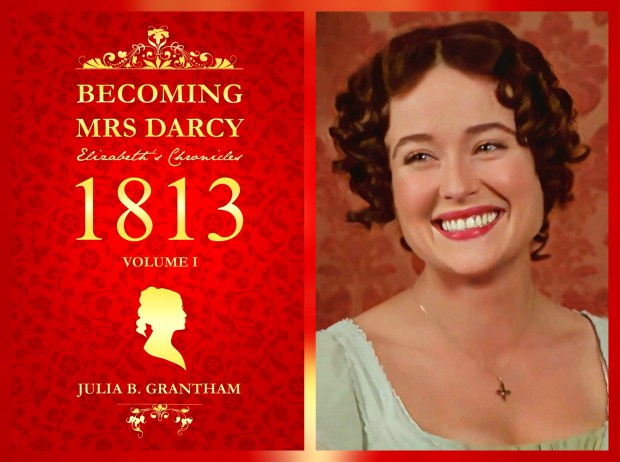
When I set out to write Becoming Mrs Darcy, I wished not only to continue Austen’s characters with gentleness and fidelity, but also to echo the very manner in which her great novel first appeared in print. My hope has been that every detail, however small, might pay homage to Pride and Prejudice. It was an ambitious undertaking, and I know too well that to copy every detail was impossible. Yet there are many respectful nods in my book to its timeless inspiration.
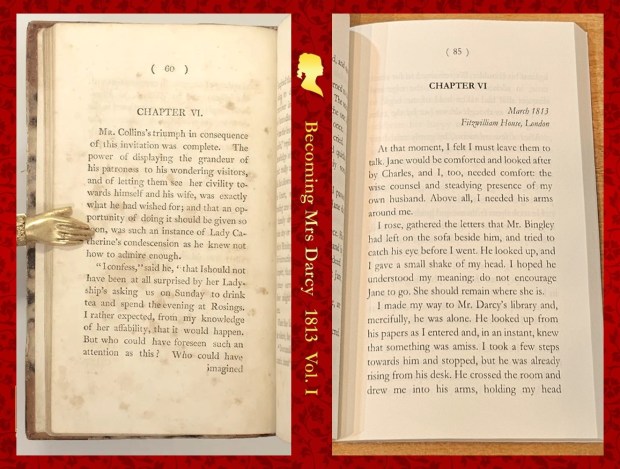
Just as Austen’s masterpiece was published in three volumes in 1813, so too will Becoming Mrs Darcy appear in three volumes. The design of the book itself follows the old tradition in ways that readers may at once recognise:
• Chapter Headings: Each new chapter begins with the word CHAPTER followed by Roman numerals, placed neatly in the centre of the page.
• Page Numbers: The page numbers are set at the top, centred, and enclosed in round brackets, as in the early editions.
• Opening Lines: The first line of each chapter, apart from the very first one, begins with a clear indent, a quiet nod to the style of the period.
• Typography and Layout: Wide margins, moderate line length, and a block of evenly aligned text recall the graceful simplicity of nineteenth-century typesetting.
• Font: While an exact match to Austen’s first edition would be practically impossible with modern technology, the font chosen is a very close likeness, carefully selected to resemble the character and size of the original.
• Elegance of Presentation: There is no bold or decorative interruption in the main text; the pages remain as uncluttered and dignified as those that delighted readers in 1813.
I hope that in this small way, Becoming Mrs Darcy may serve not only as a continuation of Elizabeth and Darcy’s journey in words, but, in its form, also as a quiet tribute to our beloved author. It is a tentative offering to mark Jane Austen’s 250th birthday and to honour the immeasurable impact she continues to have upon the world we live in. It is both a continuation and a homage, and I wait with a mixture of hope and hesitation to see whether it will be received in the spirit in which it was written.



 Julia B. Grantham, Author